

Hi, I'm Xiaochang ~ 🖐
How do you write AI prompts so it understands? In one sentence: Clearly state four things every time—Result, Context, Constraints, and Questioning Standards.If you write these four lines well, the AI will get it right the first time.
Many people are looking for AI prompt examples or a comprehensive AI prompt guide, hoping to find a single "magic spell" to paste in and be done. But after teaching so many students, I’ve found that the real difference isn’t in the spell, it’s inwhether you’ve clearly communicated the task。
This article fully reveals our 4-Line Task Assignment Method for students: why we write it this way, how to write each line, a comparison of good vs. bad prompts, and two complete examples. After reading, you’ll be able to write your own.

😵 Why Does the AI Always Misinterpret Your Prompts?
Let me start with the most common scenario. You throw out a one-liner like “Help me write an article,” and the AI quickly returns a piece. It looks complete, but it’s just wrong: too long, too formal, written for the wrong audience, and it even changed your original wording.
This isn’t because the AI is dumb. It’s because itcan only guess:
- It doesn’t know how long you want it to be or where it will be published.
- It doesn’t know your readers, nor has it seen the materials you have on hand.
- It doesn't know which specific mistake you fear the most.
- It doesn't know when it should stop and ask you, so it makes all the decisions on its own.
Think of AI as a new colleague who just started and is highly capable, and it makes sense. You wouldn't just tell a new colleague, "Write me an article," and walk away; you would give clear instructions. Giving prompts to AI is the same:The clearer the instructions, the less rework.。
🐝 A Good AI Prompt Only Needs Four Lines
These four lines correspond exactly to the four areas where "it can only guess":
- Line 1: Outcome: What the final result should look like.
- Line 2: Context: Who it is for and what resources you have.
- Line 3: Constraints: What is off-limits.
- Line 4: Question Criteria: In what situations it should stop and ask you first.
You don't need to memorize English terminology or learn any specific framework. ChatGPT, Claude, and Gemini all understand this, because it is simply how normal people delegate work. Let's break it down line by line.
🎯 Line 1 "Result": Describe the outcome so you can verify it at a glance

- ❌ Vague: Write me an article
- ✅ Clear: Write an 800-word IG post and give me 3 title options to choose from
The "Result" line should answer: After it's done, how do you know it was done correctly? The three most useful elements areQuantity, Format, Number of Versions. How many words, which platform, table or bullet points, and how many versions for you to pick from.
After writing, ask yourself: When the AI returns the result, can I immediately say "Yes" or "No"? If yes, this line is well-written.
🧭 Line 2 "Context": The AI doesn’t know your audience
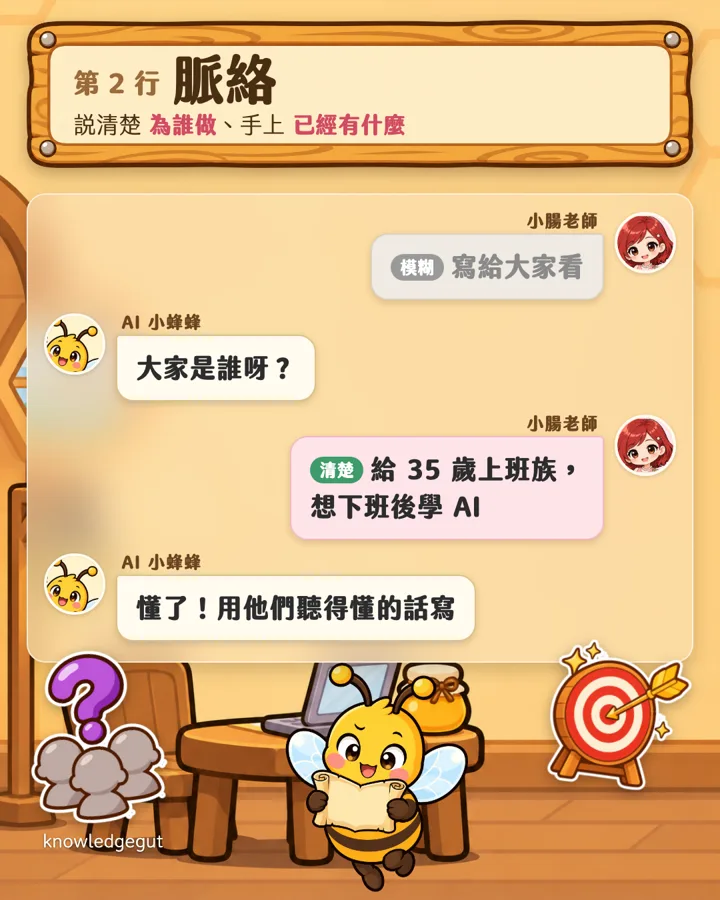
- ❌ Vague: Write for everyone
- ✅ Clear: Write for 35-year-old office workers who want to learn AI after work
Who is "everyone"? The AI can only use the most average, most boring writing style to please everyone. If you clearly define who the reader is, it will know how to use language they can understand.
Context has another half:What you already have on hand. Transcripts, old articles, conversation logs, photos—if you have them, say so and paste them in. The AI cannot see what is on your computer; if you don't provide it, it will make things up.
🚧 Line 3 "Constraints": Write down what you fear most
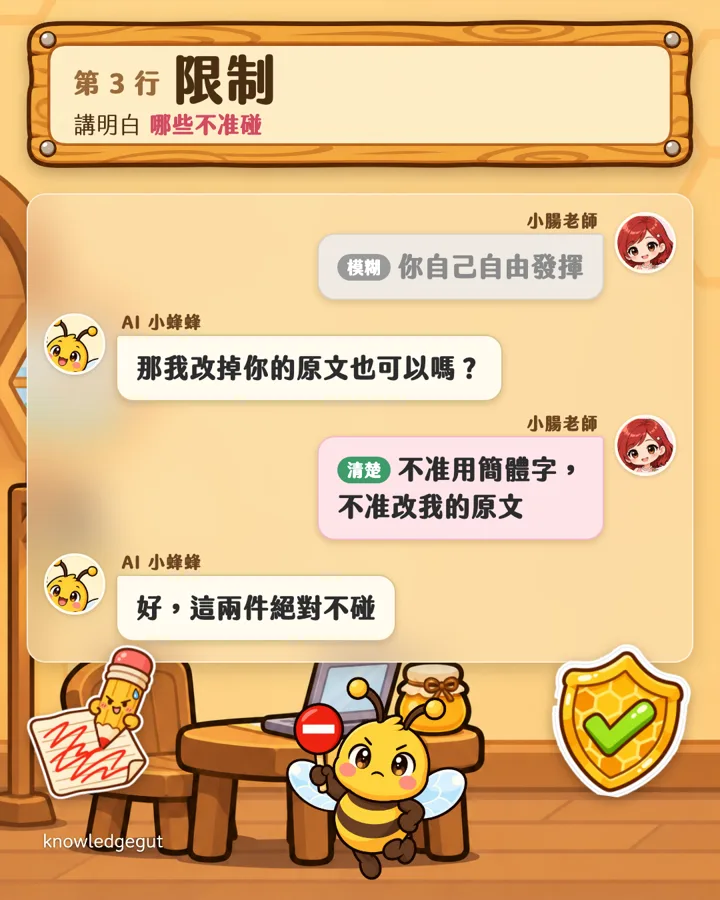
- ❌ Vague: Let the AI improvise freely
- ✅ Clear: Do not use Simplified Chinese, do not alter my original text
"Improvise freely" sounds generous, but it actually throws all the risk onto the AI. The "Constraints" line is where you writethe one thing you are most afraid it will get wrong. Common examples include: Do not alter the original text, do not guess numbers, do not use Simplified Chinese, do not promise clients things that cannot be done.
You don't need to write many items; just write one or two things you truly care about. Writing too many can actually cause them to conflict with each other.
✋ Line 4 "Questioning Standards": The line most people miss

- ❌ Vague: Ask if there are any issues
- ✅ Clear: If data is insufficient or costs are involved, pause and ask me first
If you don't clearly define what counts as an "issue," the AI will make all the decisions on its own and confidently hand you a wrong answer.
This line specifies: which matters it can judge on its own, and which ones it must ask you about first. Typically, there are three types of situations where it should ask first:Insufficient data, costs involved, or matters affecting others. I consider this the most valuable line, and it is the least commonly seen in typical AI prompt examples.
📝 AI Prompt Example: One Sentence vs. Four Lines—What’s the Difference?
Just looking at the breakdown isn't enough; let's look at the complete version. The following two are both work orders from our instruction pack.
▍Example 1: Write an IG post
Original one-liner: "Help me write an IG post." After converting it to four lines:
Result: Write an 800-word IG post and provide 3 title options for me to choose from.
Context: Target audience is 35-year-old office workers who want to learn AI after work; I have a verbatim transcript of a class on hand.
Constraints: Do not use Simplified Chinese; do not alter sentences from my original text.
Question Standard: If data is insufficient or costs are involved, pause and ask me first.
Note the second line: "I have a verbatim transcript of a class on hand." Paste the transcript below when sending. The AI will write based onyourscontent, not the average from the internet.
▍Example 2: Organize meeting minutes
Original one-liner: "Help me organize meeting minutes." After converting it to four lines:
Result: Organize this meeting transcript into a one-page summary, divided into three sections: "Decisions made / Who is doing what / Deadlines."
Context: To be sent to a manager who did not attend the meeting; I will paste the transcript below.
Constraints: Only include what was actually said in the meeting; do not add guesses; keep names exactly as in the original.
Question Standard: If it's unclear who said something, or if deadlines are vague, list them and ask me first.
The key point in this example is the constraints and question standards. The biggest risk with meeting minutes is the AI "helpfully" adding a deadline that no one mentioned, causing problems if the manager acts on it.
🎁 A blank four-line template, plus ready-to-use work orders for creating presentation outlines, replying to client messages, and organizing receipts for reimbursement, all organized for you
👉 One-click copy version of the AI Work Order Instruction Pack, get it for free
✅ AI Prompting Tips: Ask Yourself 4 Questions Before Hitting Send
After writing, don't rush to hit send; you can check off each item before submitting:
- Outcome: Can I verify it at a glance once it's done? (Did I specify the word count, format, and number of versions?)
- Context: Can someone who has never seen my data understand it?
- Constraints: Did I write down the one thing I'm most afraid it might get wrong?
- Questioning Standards: Which decisions can it make on its own, and which ones must it ask me about first?
The last two questions are where people most often get stuck. Many write good outcomes and context, but leave constraints and questioning standards blank, forcing the AI to guess in those areas.
❓ Common Questions About AI Prompts and Instructions
▍What’s the difference between AI instructions and prompts?
They all refer to the same thing. "Prompt" is the translation of the English term, while "instruction" is a more casual way to say it. Both refer to "the text you type to the AI." The name doesn't matter; what matters is whether that text clearly conveys the outcome, context, constraints, and questioning standards.
▍Is there a comprehensive list of AI prompts I can just copy?
There are many online, but honestly, the problem with comprehensive guides is thatthey are written for other people's situations. They don't include your readers, your data, or the things you fear most. Even if you copy them, the AI still has to guess in those areas. The four-line template is more like a fill-in-the-blank skeleton; it works for different tasks and different audiences. Once you learn it, you won't need to search for comprehensive guides anymore.
▍Do these work with both ChatGPT and Claude?
All of them work. Gemini and Copilot are the same; the four lines are meant for any AI.
▍Do I have to write all four lines?
I recommend writing all of them. If you miss one line, the AI will guess in that area. The most common errors occur when constraints and questioning standards are missing.
▍Do I have to write prompts in English for them to be effective?
No need. Most commonly used AIs understand Chinese well. Just write in the way you normally speak. Clarity matters far more than the language used.
🌭 Conclusion: AI Doesn’t Lack Capability; It Lacks Your Clarity
Looking back at these four lines, you'll notice that none of them are "techniques." They are all aboutwriting down what you take for granted in your head. You know who the readers are, you know what you fear most, and you know which questions to ask first. The AI does not.
Next time you ask AI to do something, don't rush to type a single sentence. Spend 30 seconds writing four lines. Getting it right the first time saves far more effort than going back and forth five times.
Once you're done, feel free to send it over so I can see what kind of work you've assigned~
📋 Too lazy to write it yourself? Just grab a ready-made one.
A four-line blank template + 5 filled-out work orders + a pre-submission checklist. Copy and paste to AI with one click to use.

Xiaochang🌭 (Yang Ting-ya / Phoebe Yang)
AI Second Brain Application Specialist
Turn knowledge into assets and let experience compound—
Train your First Brain, build your Second Brain (Heptabase), and master your AI Third Brain.
Specializing in Zettelkasten Notes, self-created memory-technique Notes, AI Automation, and AI Agent Systems.
Has coached 2,000+ professionals in building personal knowledge bases.
📩 Gut Talk Newsletter · IG @knowledgegut · Threads @knowledgegut

If you have any questions about the article content, or if there are any parts you'd like me to elaborate on, feel free to leave a comment below and let me know~
Some links in the article are "Affiliate Marketing" links. If you click through and make a purchase, Xiaochang receives a tiny little bit of commission (it won't affect the price).

by Knowledge Management Mentor Xiaochang🌭



 English
 繁體中文
 日本語