First Brain
AI helps you think; it doesn't think for you.
usingZettelkasten MethodwithSelf-Created Memory Technique Note-Taking Method, turning "remembering and understanding" into trainable muscles—relying not on tools, but on your brain itself.
My real name is Yang Ting-ya (Phoebe Yang). From the failure of my physical event business to helping a group of people turn the Second Brain from a "concept" into something they "use every day."
Turn your knowledge into"Personal Assets That Compound"——
Train your First Brain, build your Second Brain, and master the AI Third Brain.
First time here? Start hereStart Here · Want to invite a speech or collaborate?Write to Me

From the failure of my physical event business to helping 30 students get their PKM running. Five key milestones.
I hadn't finished a single extracurricular book before turning 30, and my 35K monthly salary was the lowest among my peers. For the first time, I seriously thought—"The books I never read would eventually come back to find me in this way."
I encountered a highly capable but PUA-prone life coach. I gained 15 kg in three months, knelt down, and wrote letters of repentance. After leaving, I asked myself—"Everything is learned for oneself."
After two years of studying business, I realized, "I've become very good at collecting Knowledge, but I have no idea how to use it." Then I opened Heptabase—"Ah, so this is what my mind can look like."
Friends around me bought several PKM courses but still couldn't get it running. I started offering 1:1 consultations, reviewing vaults, refining workflows, and tracking progress. I established Caitopang Co., Ltd., and my monthly income increased sixfold. I gave 25 talks across the strait.
30-person bi-monthly cohort, personally mentored: includes product managers, freelance consultants, scholars, creators, and psychotherapists. Authentic student testimonials will gradually emerge after mid-May. The second cohort is upgraded to “AI Mind Upgrade 321,” nurturing three brains together.

I finally humbled myself and decided to learn business. Not to prove anything, just to find out—where exactly I lost last time.
I never liked reading since I was young. It wasn't that I couldn't learn; I just disliked being told "what you should study." In high school and college, I got into fights, skipped class, hung out at internet cafes, and played in a band. My family's four-character verdict on me was: "Good for nothing."
At 30, I made the first major decision of my life—start a business. A physical event business, to be specific. It failed completely—burning through my money, time, confidence, and relationships all at once.
That was the first time I seriously thought: the gap between "wanting to do it" and "being able to get it done" isn't passion, it'sthe books I never read. Before I turned 30, I hadn't finished a single extracurricular book, and my monthly salary of 35K was the lowest among my classmates.

After that year of failure, I seriously studied business. I read books, took courses, and took Notes every day, barely leaving the house for a year and a half. During this time, I met a life mentor—he was truly amazing. What I learned from him transformed me from "someone who can't get things done" to "someone who can get things done."
But the cost was very real: kneeling, writing letters of repentance, gaining 15 kg, and hair loss. After leaving that relationship, I asked myself one question:
“If I could be changed by one mentor,
why can’t I dive into the sea of books and consult many more teachers?”
This question changed my life. From that moment on, I startedLearning for Myself—not to please anyone, not to prove anything, but simply because Learning itself brings me joy.


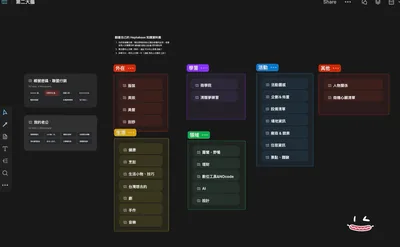
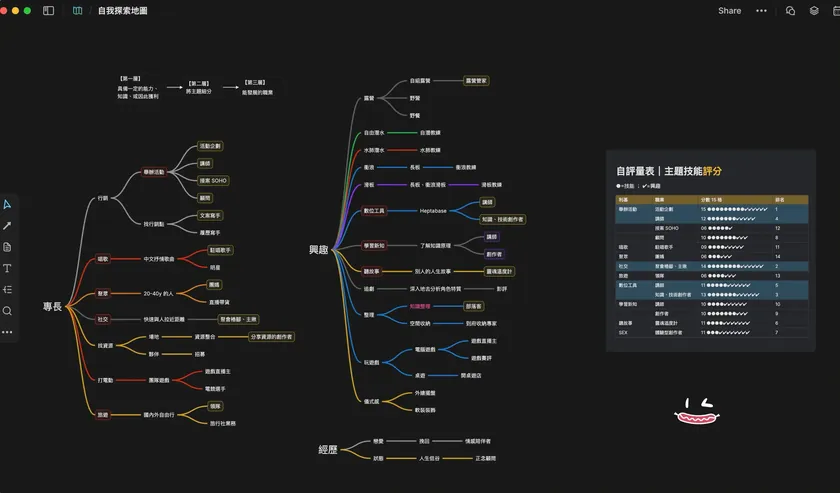
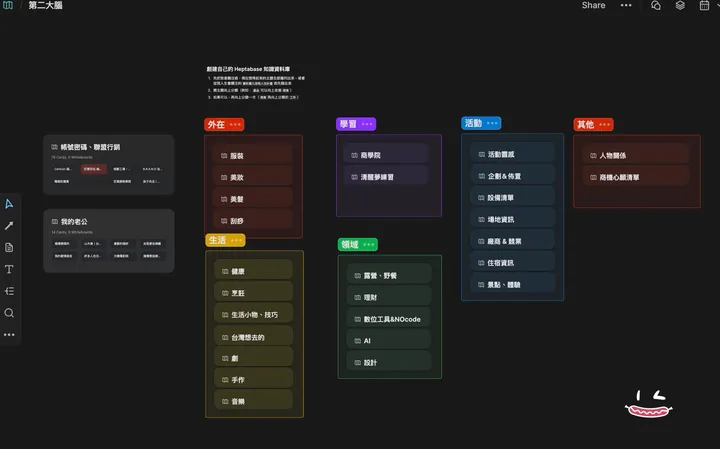
My Heptabase contains 8,800+ cards, 670+ whiteboards. This system has nurtured my blog, Gut Talk Newsletter, Threads, and courses—all my content output grows from the same Second Brain.
After studying business for two years, I realized a problem—I read so much and took so many Notes every day, but I couldn't remember where the key points were. I became very good at "collecting knowledge," but completely unable to "use knowledge."
During that period of anxiety, I encountered Heptabase—a tool for organizing thoughts using whiteboards and cards. The first day I opened it, I felt like "Ah,so this is what my mind can look like」 feeling.

Not because it’s the most profitable—online courses earn more. But because it truly works.
In the second half of 2024, I discovered something interesting—among my friends and students who had taken several PKM courses, not a single one had actually gotten their Second Brain running.
I went through their vaults: the card granularity was too coarse, tags were scattered, the inbox was never processed, and writing articles started from scratch instead of growing out of cards—these are problems you can’t learn from a hundred online courses. You need someone whocan watch over youto point them out before things change.
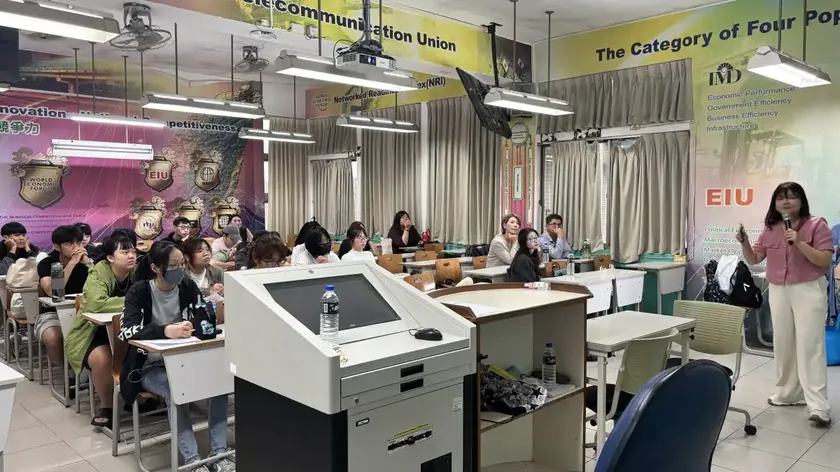
So I started offering 1:1 PKM consultations. I accompanied individuals one by one, reviewed their vaults, refined their workflows, and tracked their progress. I established Caitopang Co., Ltd., and my monthly income grew from 35K to 300K. I gave 25 talks across the strait, from Taipei, Shanghai, and Hangzhou all the way to Suzhou and Jiangsu.


A teacher who truly knows every student, using my brain to accompany you unreservedly for a stretch. I don’t promise how much you’ll earn per month or that your system will be built in a few months—promising results is sales talk, not my brand.
In March 2026, I launched the first cohort of the SHAPE Knowledge Management PKM course, enrolling 30 students. It’s a bimonthly program covering everything from tool selection to workflow implementation, with me guiding you personally. The participants included product managers, freelance consultants, scholars, creators, and psychotherapists.
Real testimonials from the first cohort's students will appear gradually after mid-May. For the second cohort, I upgraded it to"AI Mind Upgrade 321": The first brain for thinking, the Second Brain for nurturing your knowledge base, and the third brain for managing AI employees—nurturing three brains together. Classes start on 10/22, with live streams every Thursday at 8 PM.
This path is slow, deep, and expensive, and cannot be scaled—but this is the format I have chosen.Prioritize warmth over scale。
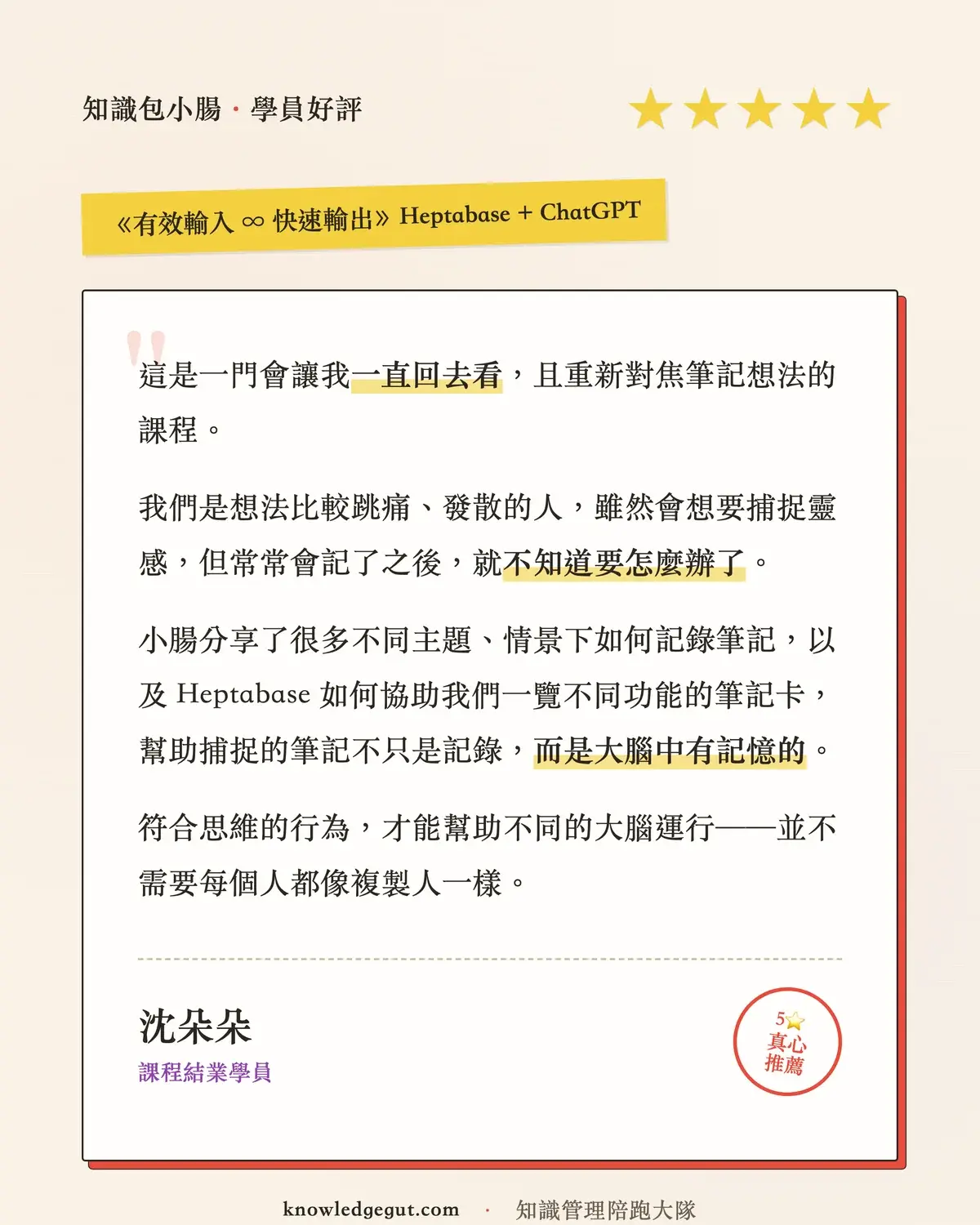
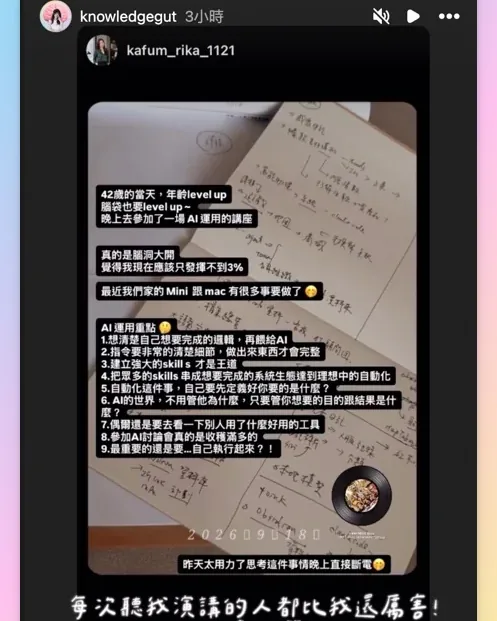
Real messages from course reviews, lecture feedback, and newsletter replies.

“Taking this class, you will absolutely not feel bored”

AI anxiety, there are many good ones


The concepts have been clarified, and it feels like I don't need to be limited to a specific platform
Train your First Brain, build your Second Brain, and master the AI Third Brain—run all three layers together, and knowledge will compound.


AI helps you think; it doesn't think for you.
usingZettelkasten MethodwithSelf-Created Memory Technique Note-Taking Method, turning "remembering and understanding" into trainable muscles—relying not on tools, but on your brain itself.


Put anything in, and find it easily.
using Heptabase Dual-Layer Architecture, turning daily absorbed content into cards that “come back to find you” — each card accumulates compound interest, rather than dying after being saved.

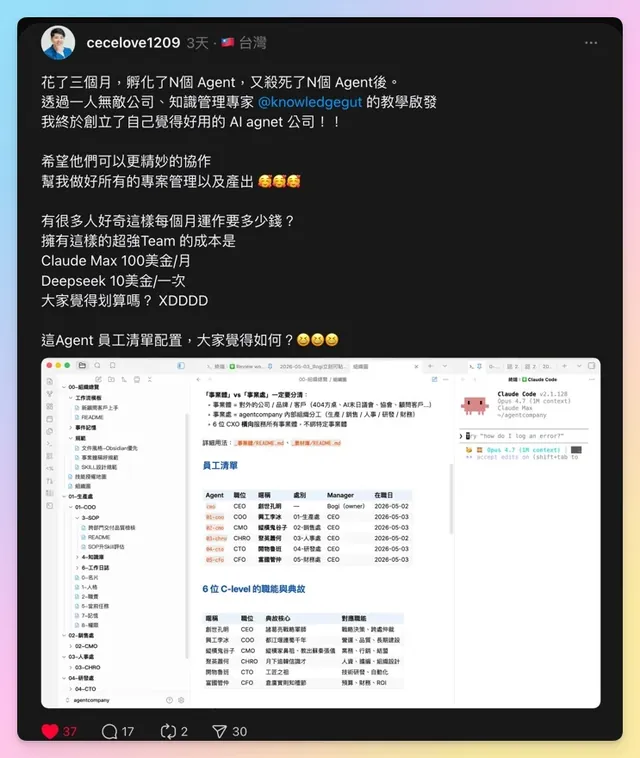
No coding required. Use natural language to train a team of AI employees who know you and handle repetitive tasks for you.
using AI AutomationwithAI Agent Systems, turning every AI tool into an employee with an SOP — you make the decisions, while the Third Brain handles the repetitive processes.
Long-form articles on the blog, 2–4 emails per month in the newsletter, daily snippets on Threads, and tutorials in the Academy.
This isn’t sales talk. It’s the real path I’ve walked over the past 8 years.
Want to chat about whether your current situation is a good fit? Subscribe to the Gut Talk Newsletter to observe me first, or write me a letter directly.